
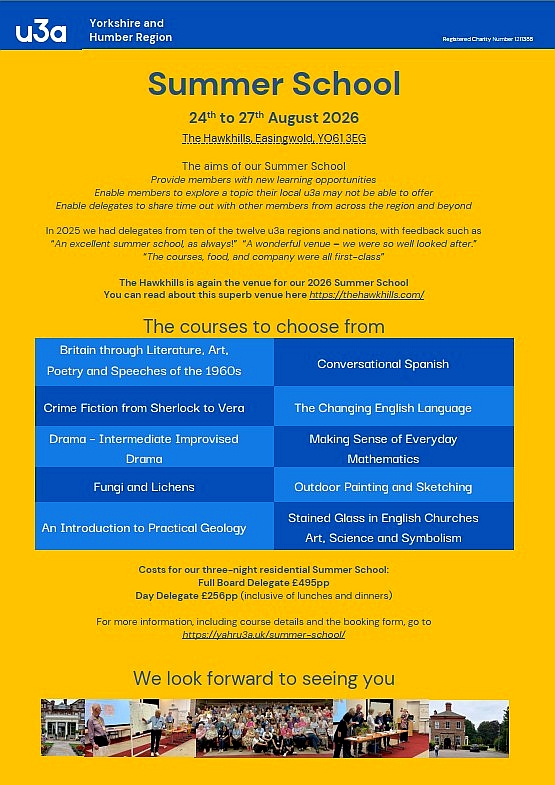
Select here to download the above flyer
Select here to download the course notes
select here to download the application form
SUMMER SCHOOL 2026 TUTORS and COURSES
1. Tutor: Tony Daniels Delegates: 20
Title: Whodunit? Crime Fiction from Sherlock to Vera
Description: Crime fiction is one of the world’s most popular literary genres. Indeed, it has been estimated that as many as one in every three new novels, published in English, is classified within the crime fiction category. This course will explore the story of fictional detectives from the earliest times, through Conan Doyle’s Sherlock Holmes, the Golden Age of detective fiction between the Wars and the rise of Professional police detectives after World War II. We’ll look at crime fiction in the 21st– century and especially detective fiction in the northeast of England (particularly Yorkshire).
Most important will be your contributions in discussion sessions looking at topics related to crime fiction (e.g. Discuss the changing relationship between the amateur sleuth and the official police force. How has the depiction of Scotland Yard and other police bodies evolved over time? What are your feelings about television adaptations of detective fiction and the liberties taken by producers? and more). We’ll explore great works of detective fiction and your favourite authors and fictional detectives.
2. Tutor: Derek Barker Delegates: 20
Title: Art, Science and Symbolism: the history of stained glass in English churches
Description: Church buildings have been embellished with stained and coloured glass since the Anglo-Saxon period. Much medieval church glass was destroyed at the Reformation and during the English Civil War, but what remains is evidence of extraordinary artistry. It is estimated that 80,000 Victorian stained-glass windows still survive, and many modern artists work in this medium. This course will cover the science of coloured glass, the production of glass windows, the symbolism of the scenes portrayed and the designers & manufacturers who have worked with glass in England. Participants should then be equipped to make their own assessments.
3. Tutor: Niall Clarke Delegates: 12
Title: Practical geology for the interested amateur
Description: The course will introduce key themes in geology, how we use different geological techniques to understand the evolution of our planet. There will be a strong visual and practical element including looking at hand specimens of rocks and minerals; maps and landscapes; developing skills you can take away and use while out and about in Britain or on holiday. We rely on the earth for the resources needed to sustain us and we will look at the geology of two of these, copper (a key material for the ‘green’ revolution) and water. We will also look at the permanent footprint we are leaving on our planet. The course is about introducing ideas and developing skills.
4. Tutor: David Martin Delegates: 12
Title: Making sense of everyday mathematics.
We will take a look at the mathematics we meet day by day to increase our understanding of it.
Description: This course will improve our mental maths, increase our awareness of the shapes and number patterns around us. Using everyday contexts we will make greater sense of probability. We will investigate what to look out for when shopping for best buys and get a better feel for percentages.
This will be a course for all levels of mathematics ability, for those fearful or confident in mathematics. No prior reading or warm up exercises are needed. Come rusty or polished in mathematics and we will learn together and have some fun.
Teaching style is by workshop including working together, with topics introduced by interactive lecture.
5. Tutor: Frances Green Delegates: 10 to 12
Title: Outdoor Painting and Sketching
Description: Come and experience the wellbeing benefits that outdoor painting and sketching offers. ‘Plein Air’ painting and sketching means using your creativity to produce art in an outdoor environment where you can capture what you see and feel ‘in the moment’. It is stimulating, involving, relaxing, sociable and lots of fun. You don’t need much equipment – a sketch pad and / or watercolour paper, a small selection of pencils, pens and / or watercolour paints and brushes.
During our sessions, we will focus on the different elements in the landscape and grounds of Hawkshill that inspire us and capture the light, weather and, most importantly, the feel and atmosphere of our beautiful surroundings.
6. Tutor: Elisabeth Macdonald Delegates: 12
Title: The Changing English Language
Description: How and why has the language grown and changed, and where is it going? An interactive sharing of our language experience, based on its history.
7. Tutor: Denise West Delegates: 16
Title: Talking About Our Generation
Description: This course looks at what was happening in 1960’s Britain through the Literature, Art, Poetry and Speeches of the time . A decade when London had transformed from a bleak post- war city to a colourful capital full of hope and promise and where anything seemed possible .
Set texts :- Billy Liar. by Keith Waterhouse.
The L -Shaped Room by Lyn Reid -Banks
8. Tutor: Roy Stewart Delegates: 15
Title: Fungi and Lichens
Description: The course will start by describing what fungi are and where they sit on the tree of life and their unique position and then concentrate on their structure, biology, ecology and evolution. We will then go into detail on their association with plants, especially trees and the controversial idea of the ‘Wood Wide Web’ and the evidence for it. Fungi have many uses in medicine and have saved countless lives but they are also notorious and potential pathogens and both these will be discussed in detail. Fungi are now at the front for replacement of materials both in fashion and building and also in trying to clear up the mess left in the environment by contamination and therefore the concept of bioremediation and examples of all these will be given. Fungi have also been used as a murder weapon and the recent case in Australia will be examined. The final session will concentrate on Lichens . These are incredible collaborations between different organisms and not quite as simple as once described and this will be discussed and their unique ability to colonize extreme environments. They have also been used as dyes and bioindicators and these concepts will be highlighted.
Please note: although fungal features will be mentioned and certain fungi identified this is not a course on identification of fungal species and no responsibility is taken for identification or misidentification
9. Tutor: Hazel Ward Delegates: 6 to 12
Title: Conversational Spanish
Description: An opportunity to revise and practise everyday Spanish in a variety of situations at basic level and above
10.Tutor: Ian Fisher Delegates: 15
Title: Intermediate Improvised Drama
Description: Improvised drama is a course aimed at teaching the techniques to be able to create a piece of theatre that is not reliant on learnt lines and is open to all. In this course we will apply various drama conventions to extracts from Our Country’s Good by Timberlake Wertenbaker and A Midsummer Night’s Dream by William Shakespeare. The aim is to consider, in a practical way, how the scenes can best be performed. Individuals will be given the confidence and skills to know that they will not fail to produce interesting and enjoyable pieces of drama and will gain an insight into the role of the director and workshops in producing these scenes. Participants will constantly be interacting with other members of the group in a supportive and non-critical environment and always within the individual’s comfort zone. No previous “acting” experience is needed just the willingness to join in and most importantly have fun, learn, laugh and enjoy the whole creative process.
 YAHR
YAHR 